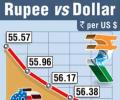
Foreign institutional investors pulled out Rs 86.66 crore (Rs 866.6 million) from local stocks on Monday, as per provisional BSE data.

Stock markets would be largely driven by macroeconomic data, auto sales numbers, FII inflows and global trends this week, analysts said. The US debt ceiling negotiations and institutional flows will also be watched by investors. "This week, market participants will closely monitor institutional flows, as there is a historical observation that when both FIIs and DIIs become net buyers simultaneously, there is a likelihood of some profit-booking in the market," said Santosh Meena, head of research, Swastika Investmart Ltd.

In worldwide trade, the US dollar continued its highly bullish trend against all major emerging market currencies

The American currency regained its buoyant strength after a brief sideways movement following overnight US Fed's optimistic tone about the future of the US economy
Equity market will be guided by global trends, macroeconomic data announcement and foreign fund movement in a holiday-shortened week ahead, analysts said. Movement of the rupee and Brent crude oil will also remain in focus this week, they added. "The bulls need some support from global markets to continue Friday's momentum.

Trading in the domestic stock market would be influenced by trends in the global equities, macroeconomic data and foreign fund movement in a holiday-shortened week, analysts said. Markets may face volatile trends on Monday after Federal Reserve Chair Jerome Powell's speech at the Fed's annual economic symposium in Jackson Hole on Friday.
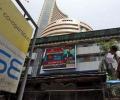
As many as 267 of 453 companies from the BSE500 index are trading above their consensus price targets, according to the data compiled by Bloomberg. Not all companies in the BSE500 index are tracked by analysts.

The listed information technology (IT) subsidiaries of engineering giant Larsen & Toubro (L&T), LTIMindtree (LTIM) and L&T Technology Services, have seen sharp upmoves over the past fortnight, with returns ranging from 14 to 18 per cent. Both have outperformed the peer index, the National Stock Exchange Nifty IT, which has gained about 8 per cent, while the benchmark Nifty 50 is up 4 per cent during this period.

The rupee strengthened by 13 paise to 61.67 against the US dollar at close.

Tracking a recovery in local shares, the Indian rupee on Friday snapped a two-day declining trend and bounced back by 39 paise to end at 61.44 against the Greenback on fresh dollar selling by exporters and some banks.

A weak US dollar in overseas markets was the main reason for the rupee's rise even as losses in domestic stocks and some fag-end dollar demand from importers prevented further gains

Reserve Bank of India (RBI) Governor Shaktikanta Das has said the decision on interest rate moderation will be based on long-term inflation trajectory and not monthly data. The Monetary Policy Committee (MPC) headed by the RBI Governor is scheduled to meet between October 7 and 9 and take call on interest rate. The RBI kept the repo rate unchanged at 6.5 per cent for the ninth time in a row amid risks from higher food inflation.

Gold burnished its image as the go-to asset class during turbulent times. However, investors seemed to have missed the bus. Net inflows into gold exchange-traded funds (ETFs) plunged to a four-year low of Rs 653 crore in 2022-23 (FY23), even as gold emerged as the top-performing asset class.

'Investors with foreign currency-denominated goals, such as foreign education or foreign travel, should go for US equity funds.'

For the week, the battered rupee gained 26 paise against the greenback

The rupee largely shrugged off the high volatility in stocks and rebounded sharply towards the fag-end trade following bout of dollar selling by exporters

'India's fundamentals are a lot better (than those of other emerging market economies).' 'India will suffer (witness a fall in its stock market) what I call the second order effect.' 'And the second order will happen when these funds (belonging to macro and hedge fund investors and which have leveraged Japanese yen-carry trades), because they lose money elsewhere as lot of their positions were financed by borrowing Japanese yen, will have to book profits in investment destinations where they are making money, including in markets like India.' 'They (these investors) will have to effectively sell in countries like India and which is the consequence (the crash in equity markets) that Indian markets might see.'

The RBI under former governor Shaktikanta Das resisted pressures to cut interest rates through 2024 as it kept its 'Arjuna's eye' trained on inflation, but the central bank under a new detail-oriented head will soon have to take a call if it can continue sacrificing growth. Das, a career bureaucrat who in 2016 oversaw Prime Minister Narendra Modi's highly disruptive demonetisation move, left a lasting legacy as he demitted office towards the end of 2024 after expertly navigating monetary policy for six years, the highlight of which was steering India's recovery through the pandemic.

India's foreign exchange reserves declined by a whopping $4.343 billion to $367.646 billion.

The rupee depreciated 40 paise to an all-time low of 81.93 against the US dollar in early trade on Wednesday as the strengthening of the American currency and risk-averse sentiment among investors weighed on the local unit. Moreover, a negative trend in domestic equities and significant foreign fund outflows sapped investor appetite, forex traders said. At the interbank foreign exchange, the rupee opened at 81.90 against the greenback, then fell to 81.93, registering a fall of 40 paise over its previous closing.

Dealers attributed the rupee's fall to increased demand for the US currency from importers.

The rupee dropped on renewed demand for the American currency.

The domestic equity market, which is on a record-breaking spree, will focus on macroeconomic data announcements, movement in global stocks and the US Fed minutes to get further direction, analysts said. Trading activity of Foreign Institutional Investors (FIIs) will also innfluence investors.From the domestic macroeconomic front, Purchasing Managers' Index (PMI) data for the manufacturing sector will be released on Monday, and that o,f the services sector on Wednesday. Investors, this week, will keenly watch major global market events, icluding the outcome of the Federal Open Market Committee (FOMC) minutes, scheduled to be out on Wednesday.

Within three trading sessions in May, foreign portfolio investors (FPIs) have pumped in Rs 9,461 crore into Indian equities. This follows net inflows worth Rs 7,936 crore in March, and Rs 11,631 crore in April. The trend, analysts said, could continue going ahead as the US Federal Reserve may soon halt its interest rate hike cycle, which will strengthen foreign fund inflows into emerging markets, including India.

The rupee had last ended at 67.22 per dollar on March 16, 2016.

Ongoing trade-war rhetoric between the US and China added some nervousness on the trading front coupled with extremely bullish dollar sentiment overseas.

BSE benchmark Sensex nursed losses on Friday as investors pocketed gains after a five-session winning streak amid a bearish trend overseas. A depreciating rupee and foreign fund outflows further soured risk sentiment, traders said. The 30-share gauge, which had started the trade on a firm note, soon gave up all the gains and finally ended 651.85 points or 1.08 per cent lower at 59,646.15. The broader NSE Nifty snapped its eight-day rally to close at 17,758.45, down 198.05 points or 1.10 per cent.

Equity indices fell on Thursday, mirroring weak global market trends following the US Federal Reserve's interest rate hike and hawkish stance. The 30-share BSE Sensex declined 337.06 points or 0.57 per cent to settle at 59,119.72. During the day, it tanked 624 points or 1.04 per cent to 58,832.78. The NSE Nifty went lower by 88.55 points or 0.50 per cent to end at 17,629.80.

Foreign portfolio investors' (FPIs') net investments in the domestic debt market surged in December, marking a 77-month high, that is, since July 2017. According to market participants, this significant uptick in FPI inflows can be attributed to the post-domestic policy outcome and the US Federal Reserve's dovish stance at the December policy. FPI inflows into debt stood at Rs 18,393 crore in December against Rs 14,106 crore in November, according to data on the National Securities Depository Limited.

In a data-packed week, the domestic macroeconomic figures -- industrial production and inflation numbers -- along with global trends would dictate trends in the equity market this week, analysts said. According to experts, markets may face volatile trends due to high valuations. Equity benchmark indices Sensex and Nifty hit their fresh record peaks on Thursday. Besides, trading activity of foreign investors, movement of global oil benchmark Brent crude and rupee-dollar trend would also influence trading in equities.

RBI governor Raghuram Rajan, on Monday, said the current level of the rupee is "pretty reasonable" and any attempt to devalue it may lead to a surge in inflationary pressures and "offset any benefits"

With no major domestic market-moving event scheduled this week, stock market investors would largely focus on global trends and foreign fund movement, and may face volatility amid monthly derivatives expiry, analysts said. This week Federal Open Market Committee (FOMC) meeting minutes are due for release which would provide further cues to the market, Siddhartha Khemka, Head - Retail Research, Motilal Oswal Financial Services Ltd, said. "With all major events behind us, participants will take cues from global markets, crude and currency market movement.

All the indicators point to a further steady weakening of the Rupee.

Global trends, macroeconomic data announcements and the start of the earnings season would be the major drivers for the equity markets in a holiday-shortened week, analysts said. Equity markets will remain closed on Thursday for Eid-Ul-Fitr. Trading activity of foreign investors, rupee-dollar trends and crude oil prices would also guide trends in markets.

Some of the world's biggest banks including HSBC, JPMorgan Chase and Standard Chartered moved trillions of dollars identified as being potentially tied to money laundering or other crimes despite raising concerns about those transactions in filings with US regulators, reports South China Morning Post.

Rating agency Fitch on Tuesday downgraded the US government's top credit rating to AA+ from AAA, citing fiscal deterioration over the next three years and repeated debt ceiling negotiations. The development caused a flutter across equity markets, with most leading frontline global equity indices trading weak. Back home, the S&P BSE Sensex and the Nifty50 lost over 1 per cent each in intra-day deals to hit a low of 65,751.53 and 19,517.55 levels, respectively.

From the Sensex basket, Kotak Mahindra Bank, HCL Technologies, ICICI Bank, Infosys, Tata Consultancy Services, Wipro, Tech Mahindra and Larsen & Toubro were the major laggards. Mahindra & Mahindra, Nestle, Tata Motors and IndusInd Bank were among the gainers.

Forex traders said a stronger dollar also dragged the rupee down.

Equity benchmark BSE Sensex closed at an all-time high of 62,272.68 on Thursday, tracking a firm trend in global markets after the US Fed minutes indicated a slower pace of rate increase that bolstered investors' sentiment. Extending its rally to the third straight day, the 30-share BSE benchmark rallied 762.10 points or 1.24 per cent to settle at 62,272.68, its record closing peak. During the day, it jumped 901.75 points or 1.46 per cent to its lifetime high of 62,412.33.he broader NSE Nifty gained 216.85 points or 1.19 per cent to end at 18,484.10.

Rs 1,000 now buys $13.5 against $14 a year ago.
